


The Venetian islands of Methoni (GB)

Bijgewerkt op: 27 jul
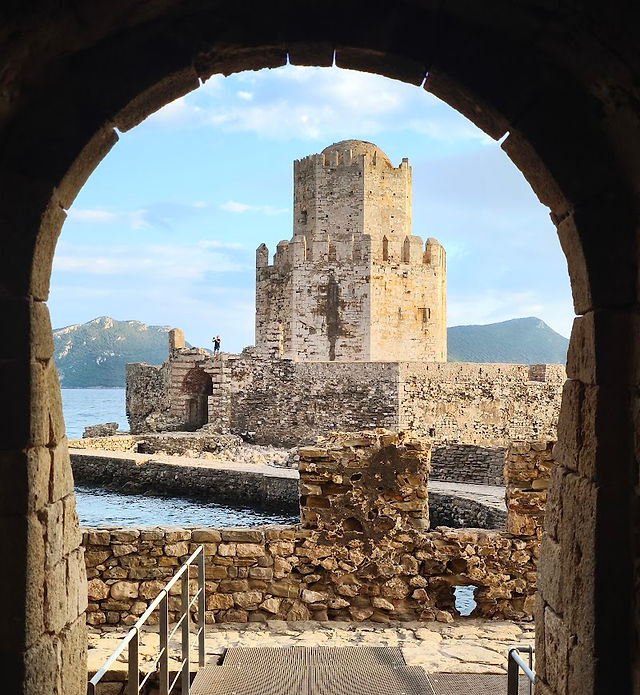
Whenever I stand on the Venetian walls of Methoni Castle, I look towards the sea. Most people notice the beautiful blue water first, then spot a single island. But there is much more out there than meets the eye.
What you are actually looking at is a small group of islands called the Messenian Oinousses. Together they have watched over this coastline for thousands of years. Roman ships, Byzantine sailors, Venetian galleys, Crusaders, merchants and pilgrims all passed these islands on their journey between Venice and the Eastern Mediterranean.
The name Oinousses probably comes from the ancient Greek word oinos, meaning wine. Historians believe this may refer to wild vines that once grew on the islands, or perhaps to the ancient wine trade that sailed through these waters. No one knows for certain, but the name itself is already more than two thousand years old.
Sapientza: The Island of Wisdom
The most famous island in the group is Sapientza, known by the Venetians as Sapienza. The Venetian name comes from the Italian word for wisdom, which in turn derives from the Latin sapientia.
Nobody knows exactly why the island received this name — no old document explains it — but most historians agree the Venetians named it sometime during the centuries they ruled this part of Greece.
To understand why, we have to go back to the Middle Ages. At that time, Methoni (known to the Venetians as Modon), together with nearby Koroni (Coron), was one of the most important ports of the Republic of Venice. Almost every Venetian ship sailing to Constantinople (today's Istanbul), Crete, Cyprus, Alexandria or the Holy Land passed along this coastline. It was one of the busiest sea routes in the Mediterranean — and not an easy one.
The sea around Sapientza is full of hidden rocks, strong currents and sudden westerly winds. Even today, experienced sailors treat these waters with respect. Hundreds of years ago, without engines, radar or GPS, the passage could turn dangerous fast. A captain needed experience, good judgement, and above all, wisdom. That, many historians believe, is how the island came to be known as Sapienza.
There is also a beautiful local legend. It is said that old Venetian sea charts once carried the words Navigare con Sapienza — "Sail with wisdom" — and that over time, people simply began calling the island Sapienza. It's a wonderful story, though historians have never actually found a Venetian chart bearing these words. Today it is considered legend rather than fact. Still, it is a legend that fits this place perfectly.
Secrets Beneath the Waves
The sea around Sapientza has kept its secrets for centuries. Many ancient shipwrecks have been discovered here — Roman, Byzantine and Venetian among them. One of the most remarkable finds is a cargo of enormous granite columns, once being transported from Egypt to Caesarea in present-day Israel almost two thousand years ago. The ship never arrived. Like so many others, it sank off the coast of Sapientza. Not far from it lies a second Roman wreck, known as the Sarcophagi Shipwreck, whose cargo of carved stone sarcophagi — most of them still intact, decorated with floral motifs — rests at a depth of about 15 metres. Finds from both wrecks are now on display at the Marine Antiquities Museum in Pylos.
Even the bay of Methoni itself holds a secret: archaeologists have identified a settlement from the Middle Bronze Age, submerged beneath the seabed. Much of it remains buried under sediment and largely unexplored, but geological surveys have revealed how the ground it once stood on gradually sank beneath the water.
The island itself has never had a real village, but that doesn't mean it was ever truly empty. Roman sailors anchored here. Byzantine ships found shelter in its natural harbour. Venetian galleys waited here for favourable winds before continuing across the Mediterranean. On the southeastern side of the island lies Porto Longo, one of the safest natural harbours in this part of Greece, where fishermen, sailors, watchmen and later lighthouse keepers all spent time living.
Most historians also believe a small Benedictine monastery may once have stood here, or perhaps a community belonging to the Knights of St. John — better known as the Knights Hospitaller. The exact location has never been found, but a place still called Fragkokklisia ("The Frankish Church") is thought by many to mark the spot.
According to several historical sources, it was also here that the famous Treaty of Sapienza was signed in 1209, confirming Venetian control over the vital ports of Methoni and Koroni. Many assume the island was named after this treaty — but it's actually the other way around. The island was already called Sapienza before 1209; the treaty simply took its name from the island.
In 1885, a lighthouse was built on Sapientza — commissioned, according to local sources, at the request of Queen Victoria herself, and constructed by English technicians. For many years lighthouse keepers and their families lived here, watching over one of the busiest shipping routes in the Mediterranean. Today the island is almost completely uninhabited.
Seen from above, Sapientza has a curious shape: a small rocky islet at its southern tip gives the whole island the outline of a heart — something you would never notice sailing around it, but which is unmistakable in aerial photographs. The island is also home to a rare natural treasure: the only place in the Mediterranean where the strawberry tree (koumaria) grows into full-sized trees, some reaching 10 metres tall. Together they form the Koumarodasos, a forest of nearly 240 acres protected as a biogenetic reserve for its scientific value.
Agia Marina: A Quiet Place of Prayer
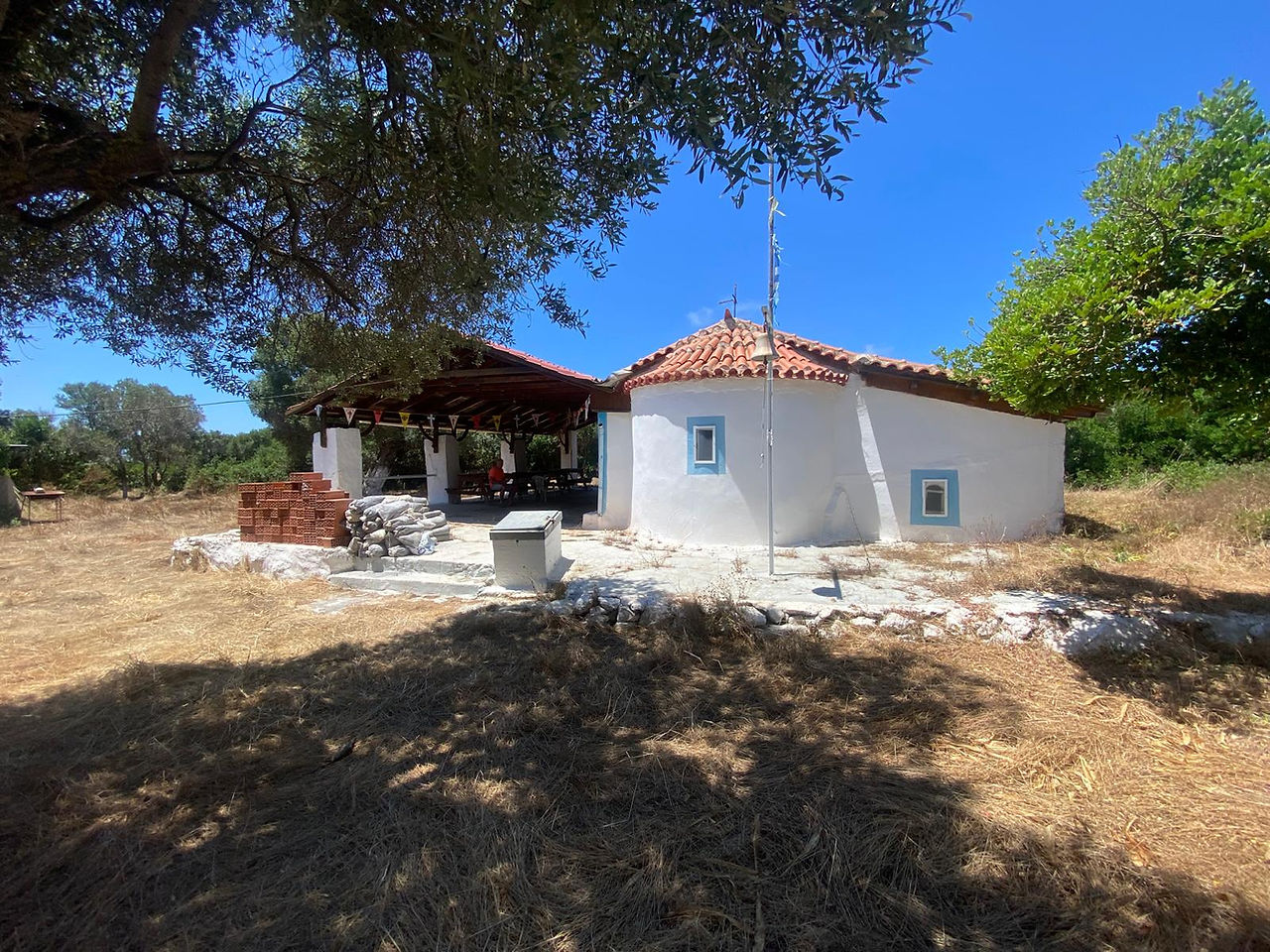
Just north of Sapientza lies the tiny island of Agia Marina, named after one of the most beloved saints of the Greek Orthodox Church. A beautiful white chapel dedicated to her stands here, and every year around 17 July, local people from Methoni and Finikounda travel by boat to celebrate her feast day — a tradition kept alive for generations.
Agia Marina has never had a permanent village. It has always been a peaceful place of prayer, a small pilgrimage destination, and a quiet stop for local fishermen. It's possible that, from time to time, a monk or caretaker stayed here to look after the chapel.
Schiza: The Island That Nature Split
South of Sapientza lies Schiza, the largest island of the group. Unlike Sapientza, this name is Greek — probably from the ancient word schízo, meaning "to split." One look at the island from the sea and you understand why: its coastline is full of deep bays, rocky cliffs and narrow inlets, as if nature itself had torn it apart.
Schiza has never had a permanent village either, but people have visited for thousands of years. Inside the famous Mavri Trypa ("Black Cave"), archaeologists discovered prehistoric pottery, proving people came here long before the Classical Greek period. Later, shepherds brought goats to graze, and in more recent years parts of the island were even used as a military training area. Today Schiza is uninhabited and forms part of a protected nature reserve.
The Smaller Islands
Around Sapientza and Schiza lie several smaller rocky islands: Venetiko, Agelia, Avgo, Bomba and Dio Aderfia ("The Two Brothers"). Small as they are, they served as important landmarks for sailors approaching the southwestern tip of the Peloponnese.
Today, the entire island group is a protected natural area. Rare Mediterranean plants grow here, and thousands of migratory birds stop on their long journey between Europe and Africa.
A Pilgrim's Tale: Pietro Casola in Modon, 1494
Methoni was not just a naval port — it was also a vital stop on the great pilgrim route from Venice to Jerusalem. From the thirteenth century onward, pilgrim galleys sailed this route every summer, and Modon, roughly midway between the two cities, was where they paused to take on food and water before continuing east.
One of the most vivid accounts of such a visit comes from Pietro Casola, a canon from Milan, born in 1427 and a respected authority on Milan's own liturgical tradition. In 1494, at the age of 67, he finally fulfilled a long-held vow and set sail from Venice for the Holy Land. Unlike most pilgrim writers of his time, Casola combined piety with real curiosity — he wrote honestly about the heat, the food, and the everyday discomforts of travel, earning him a reputation for having "a pretty gift of humour."
On his outward journey, sailing through the night from Zante (Zakynthos) to Modon, Casola gave one of the liveliest accounts we have of that crossing. It was the eve of the feast of St. John the Baptist, and nearly everyone aboard complained bitterly of the heat — except, curiously, the Germans, who seemed unbothered by it. When the galley finally reached Modon, the pilgrims were so eager to be back on solid ground that they leapt ashore before the anchor was even properly cast, only to find poor lodgings and barely a few eggs to eat in the town.
Casola's account was not published until 1855, and only translated into English in 1907. He died in 1507, thirteen years after his journey — leaving behind one of the liveliest windows we have into what it was really like to pass through Methoni in the Venetian age.
A Jewish Community on the Pilgrim Route
Christian pilgrims like Casola were not the only travellers passing through Modon on their way to Jerusalem. Jewish pilgrims and merchants used the very same Venetian shipping routes, and some of them stopped in Modon too.
One of them was Meshullam da Volterra, a wealthy Florentine merchant and jeweller who set out for Jerusalem in 1481 to fulfil a vow. Passing through Modon, he found a Jewish community of an estimated 300 families, living in a quarter on the outskirts of town and working mainly in the silk and tanning trades, as well as in shipping. This community was not new — the twelfth-century Jewish traveller Benjamin of Tudela had already recorded Jews living in Modon long before the Venetians arrived. Under Venetian rule, the community grew, and by the fourteenth century the town's population was a genuine mix of Greeks, Jews, Albanians and Latins. After the Ottomans first captured Modon in 1500, Sephardic Jews fleeing the expulsion from Spain even settled here.
That history came to an end after the Venetian-Ottoman war of 1646, when the Jewish community of Modon ceased to exist. Today there are no Jews left in Methoni — part of the much larger, and far darker, story of Greek Jewish communities, most of which were destroyed centuries later during the Holocaust.
A Place Where History Never Left
Every time I look at these islands, I see more than beautiful nature — I see more than two thousand years of history. Roman merchant ships, Byzantine sailors, Venetian galleys, Crusaders, lighthouse keepers and generations of local fishermen have all passed this way.
Perhaps that is why I love this place so much.
Whether the Venetian name Sapienza really comes from the wisdom needed to sail these dangerous waters, or whether the old legend of Navigare con Sapienza holds a grain of truth, we may never know. But after more than eight hundred years, the name still feels perfect. Because here, just off the coast of Methoni, history, nature and legend have always belonged together.






Opmerkingen